
Why People Hate Wokeness
We should do anti-racism better

The collection of social attitudes called “wokeness” is infuriating to many. Indeed, more Americans consider “woke” an insult than a compliment. However, in my view, so far no one has pinned down why wokeness provokes such resentment. Wokeness refers to the belief that injustice towards various racial and sex/gender groups, like women, gays, and blacks, is systemic, and its proponents usually require that members of privileged groups actively work to remedy this injustice. Systemic injustice is injustice that shapes social life regardless of people’s intentions. Even if you don’t consider yourself a racist, for example, the woke would say that you perpetuate racial injustice if you accept a system of cultural norms and institutions that bring about unjust outcomes.
I’ll be discussing racial wokeness, particularly as it pertains to the relationship between black and white Americans. Proponents of racial wokeness, whom I will call “wokeists,” interpret the existence of economic and social disparities between the races, like the racial wealth gap, as evidence of systemic injustice. Wokeists believe that whites are obligated to offer blacks reparations of various kinds to compensate them for our nation’s racist legacy.
The political realist framework of Bernard Williams clarifies why so many people find wokeness illegitimate and infuriating. Williams thinks that a government is legitimate only to the extent that it can justify its power to each subject. Since reparations cannot be reconciled with any plausible interpretation of what is in the interests of white Americans, there is no reason for them to accept reparations as legitimate. My claim is not that the policies recommended by the wokeists are universally wrong, but rather that they justify these policies in the wrong way.
Williams on political legitimacy
When is the exercise of government power legitimate? We typically think that power is justified when it conforms to an objective moral order. Utilitarian and Kantian theories of justice are examples of such political moralism. As I have shown in other articles, however, it is very hard to justify claims that there is any objective moral order. Such claims can be defeated by various arguments, including integrity, parsimony, and evolutionary debunking arguments.
Williams, therefore, wants to place legitimacy on a more philosophically defensible non-moral foundation. Governments are legitimate, on his view, not when they conform to a moral order, but when they can justify their use of power to subjects. Theories like Williams’ that deny that there is a moral foundation for politics are known as political realist theories.
On Williams’ view, a state cannot be legitimate if it does not provide “order, protection, safety, trust, and the conditions of cooperation.” However, establishing this order is not enough to make a state legitimate. An orderly state could be one in which a racial group was enslaved or discriminated against. This group would be justified in finding the political order illegitimate and, therefore, in rebelling. What truly makes a state legitimate for Williams is that it is able “to offer a justification of its power to each subject.”1 For example, the state must be able to justify inequality in wealth and status even to people who are at the bottom of the hierarchy. The politically powerful can’t just say, “You’re poor and powerless because that’s what’s best for us. We’re exploiting you, and we’ve got the guns, so what are you going to do about it?” Rather, for their power to be legitimate, the powerful must be able to provide justifications for the existing order. For example, they could say, “This hierarchy is the inevitable result of a free market, and the free market is the best way of organizing the economy because it tends to increase everyone’s well-being, including that of the poor. There is a huge body of economic research proving that this kind of economic system leads to the best outcomes for the most people.”
There are many forms that such justifications might take. The powerful might appeal to the subject’s economic interests or they might appeal to the subject’s emotions, loyalties, values, or cultural identity. I use the term “interests” to refer not just to the desires for wealth and power, but to the whole range of desires that might motivate a subject to accept the legitimacy of government power.
Williams’ political realism is compatible with some forms of contractarianism, or the legitimation of the law through an appeal to a social contract. While it is generally against my interests to sacrifice my wealth and freedom to others, I might rationally consent to laws that require sacrifices from me but that bring me a greater good in return. I might accept a law of taxation as legitimate, provided it was universally enforced, because the state can use my wealth to solve problems that I want to solve but can’t solve on my own, like crime and poverty. Many laws can be justified straightforwardly by this contractarian logic, like laws against murder, robbery, and other crimes, which protect subjects from harm and promote public order.
Many potential laws also obviously do not pass the legitimacy test. If the state made it the law that everyone had to attend a Christian church on Sunday morning, non-Christians of all sorts would have a powerful argument that this law was against their interests, and that the general interest would be better served by a law that allowed everyone to worship as they pleased.
The reparationist logic of wokeness
The core claim of the wokeists is that blacks are owed reparations of various sorts because of the legacy of slavery, racial discrimination, and racial exploitation. Wokeists believe that the racial wealth gap between white and black Americans is due predominantly to exploitation and that, therefore, whites are morally required to close these gaps. As Ibram X. Kendi puts it, throughout American history:
white people were collectively accumulating, compounding, and passing down wealth from selling black bodies; exploiting no-wage or low-wage black labor; stealing black assets, from the days of whitecapping to the foreclosure era; seizing opportunities, such as the New Deal or GI Bill, that were denied to black people; utilizing family wealth to start businesses; owning government-subsidized homes in government-subsidized white suburbs or gentrified neighborhoods; and cashing in on Reagan-, Bush-, and Trump-era tax cuts for the already wealthy.
One type of reparations that some wokeists demand is a cash transfer. The subtitle of Ta-Nehisi Coates’ article “The Case for Reparations” states his thesis clearly:
Two hundred fifty years of slavery. Ninety years of Jim Crow. Sixty years of separate but equal. Thirty-five years of racist housing policy. Until we reckon with our compounding moral debts, America will never be whole.
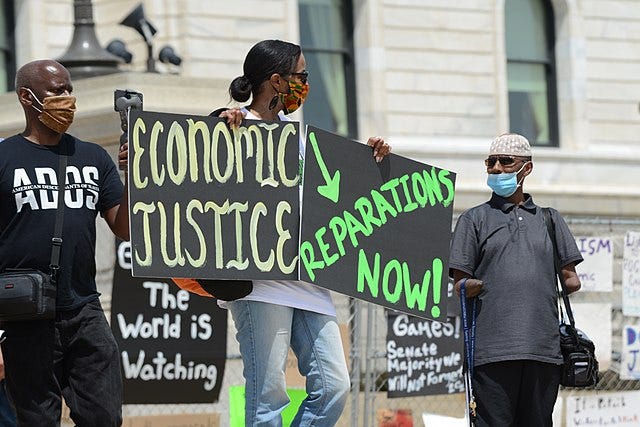
Coates doesn’t put a dollar amount on the reparations owed, but the economist William A. Darity has estimated that the federal government should hand over $14 trillion to blacks.2
Wokeists also demand reparations in the form of positive discrimination, or affirmative action. As Kendi writes, “The only remedy to past negative racist discrimination that has produced inequity is present positive antiracist discrimination that produces equity.”3 Kendi defends various forms of affirmative action, like awarding government contracts to blacks and university admissions rules that favor blacks.
Finally, wokeists think that whites owe blacks reparations in the form of racial sensitivity. In White Fragility, wokeist writer Robin DiAngelo says that in their interactions with blacks, whites are obligated “to own and repair our inevitable patterns of racism.”4 Since whites have been socialized into and profit from a culture of white supremacy, they owe it to blacks to treat them with special consideration. Whites should learn to “minimize our defensiveness” about racial issues and “interrupt privilege-protecting comfort” and “internalized superiority.”5 Whites owe it to blacks to reflect deeply on their own racism, to be ready to apologize to them, and to seek feedback about how their behavior is perceived from black people.
Are reparations legitimate?
Many have argued that reparations are illegitimate, but I will be making a case that is, I believe, original and more fundamental than the others are. Authors like Thomas Sowell and Walter E. Williams commonly criticize reparations on the grounds that they are impracticable, that the woke interpretation of American history is unfounded, and that it is inappropriate to make contemporary Americans pay for the sins of their ancestors. It is quite difficult to define who should pay and receive reparations, and it is far from clear that exploitation is really the cause of racial gaps in wealth and social status. These are valid points, but I want to go beyond these criticisms and make the case that reparations are based on an untenable theory of morality according to which people are obligated to act against their interests.
We saw above that, on the realist conception, a government is legitimate to the extent that it can justify laws and government policies to each subject. Whites, therefore, have the right to ask how reparations will make their own lives better. If the US government implemented reparations without being able to answer this question, then it would rightfully risk losing legitimacy in the eyes of whites.
Recent immigrants to the USA have particularly good reason to find reparations illegitimate because there is no plausible case to be made that they profited significantly from the exploitation of American blacks. In the interests of steelmanning the wokeist case, I will leave them out of consideration. The wokeists’ strongest case is that white people whose ancestors owned slaves, as mine did, are required to pay reparations, so I will consider blacks’ claims against this subset of white Americans.
The wokeists do sometimes argue that paying reparations is in the interests of whites, but they do not devote much effort to justifying this point. Coates, for example, says that paying reparations would create “a healing of the American psyche and the banishment of white guilt” and “a national reckoning that would lead to spiritual renewal.” However, Coates offers no proof that whites do in fact feel guilty and that their psyches need healing. Moreover, he does not justify the claim that paying reparations would lead to spiritual renewal or explain why we should want to be spiritually renewed.
Reparations require sacrifices from white people, and I reviewed the contractarian argument that it can be rational to sacrifice one’s own interests if doing so plausibly results in benefits that are greater than the sacrifice. However, it’s hard to see how reparations could be justified in this contractarian manner. If you try to apply social contract logic to the issue, you get nonsense: “If I, a white person, agree to pay reparations, then, if I am ever enslaved or exploited by another race, they will be obligated to compensate me.” There simply isn’t any realistic prospect that white Americans will be enslaved or otherwise exploited because of their race, so this contractarian argument fails.
Wokeists might argue that paying reparations would make black people less angry at white people, and that increased racial harmony would be part of what Coates calls “the spiritual renewal” of the USA. But it isn’t clear that increased friendliness between the races would inevitably or even probably result from paying reparations or would be worth the cost even if it did. It also isn’t clear what whites have to gain from increased harmony between the races. If blacks were less angry at us, how would our lives be better? Why would interracial harmony make us feel spiritually renewed?
It’s more likely, in my view, that reparations would increase hostility between the races and tend to legitimate white racism. I think most whites would find reparations an outrageous injustice and resent black people for demanding them. Reparations would tend to justify the racist sentiment that blacks are economically parasitic on whites and “just looking for handouts,” a perennial theme of American right-wing commentary. I find it likely that the fury that the idea of reparations provokes in many people, and not just white ones, is due to the fact that we intuitively think of legitimacy in political realist terms, even if we do not clearly understand our intuitions.
I said above that we should understand interests in an expansive sense that would include all human motivations, not just selfish ones. I have written that altruistic emotions like compassion are just as natural to humans as selfish ones like the desire for wealth and power. Might whites, then, be motivated by compassion to make sacrifices to blacks?
Compassion seems to me the strongest foundation for the case for reparations. Certainly, in the past, black Americans have been fitting objects for compassion. It’s hard to know how you would feel if you had grown up in a different social environment, but I certainly hope that I would have been on the side of the abolitionists and civil rights activists if I had lived in the age of slavery or segregation. I hope that compassion would have moved me to outrage at the sight of a race condemned to slavery, poverty, and powerlessness by a society that was openly contemptuous of them. And, indeed, compassion would have been only one valid reason for outrage. A regime that can deny human rights to a racial group is one in which no one’s rights are safe. It is in the general interest to make sure that a government enforces a basic level of respect for rights.
Today, however, it is much less obvious that blacks are fitting objects for compassion. The USA has made great efforts to ensure that there is no barrier in blacks’ way to participating in the economy, and blacks’ living standards have increased immensely. Many have made the plausible case that the reason for the racial wealth gap is not the legacy of racial exploitation, but dysfunctions in black culture. So it is not clear to what extent blacks are deserving of whites’ compassion anymore. Certainly, there is no good reason to think that blacks deserve of $14 trillion of compassion.
Wokeness is a morality system
Wokeness emerged from postmodernism, so woke writings contain much discussion of subjectivity and standpoints. You might expect, therefore, that wokeness would be compatible with ethical subjectivism, according to which right and wrong are meaningful only within a given standpoint. However, wokeism is not a form of subjectivism. Rather, it is a form of moral objectivism based on the assumption that people have moral obligations that are binding on them regardless of what they want. When wokeists tell us that white people are obligated to pay reparations regardless of their interests, they are assuming that there are objective standards for behavior that white people are not meeting.
Wokeists do not justify their conception of morality, nor do they appear aware that their moral vision requires any justification, nor do they appear entirely clear about what their moral vision is. They simply assume that there is some transcendent, cosmic scorecard that obligates those who have done wrong in the past to compensate the descendants of the victims. However, there is no such cosmic scorecard. Old wrongs do not necessarily need to be righted. Rather, there are only individuals who demand that governments advance their interests and who are oriented towards the future.
In Williams’ view, a morality system is defined by concepts and practices of obligation, guilt, and blame.6 These systems are based on commandments, categorical imperatives, and other precepts that you must obey regardless of what you want. Failure to conform to the moral order makes us deserving of blame and requires that we feel guilty. By these standards, wokeness is a traditional morality system in which whites are morally obligated to pay reparations, to be blamed when they don’t, and to be made to feel guilty about the racial wealth gap and other matters. I have argued elsewhere that morality systems impose a kind of oppressive psychological slavery on people that we ought to try to free ourselves from.
A better kind of anti-racism
My critique has been directed at the philosophical assumptions underlying wokeism. I do not necessarily object to the policies that wokeists propose, but to their way of justifying those policies. I agree with wokeists that many white Americans are racists and that racism impedes the achievement of the public good. I, therefore, want anti-racists to present a more persuasive and appealing political vision that makes a plausible case that anti-racism brings benefits to everyone.
One writer who is taking this win-win attitude towards anti-racism is Heather Mcghee. In The Sum of Us: What Racism Costs Everyone and How We Can Prosper Together, McGhee makes the case that the American right uses racist dog-whistles to sabotage government investments and assistance that would benefit everyone. By presenting government assistance as a handout to blacks, the right turns even poor white people against it, even though they would stand to benefit. McGhee attributes low government funding for college tuitions and healthcare, as well as many other problems, to racial animosity.7
I also agree with DiAngelo that white people should reflect on their racist biases and do their best to take the perspective of the racial other. However, I don’t think of such reflection as something that I am obligated to do to repair the harms of white supremacy. Rather, I want to do it so I can enjoy a more cordial relationship with the people around me. Nor do I think that such reflection ought to be thought of as a special burden on white people. Everyone stands to gain by better understanding the perspectives of those around them.
Reframing anti-racism in win-win terms might be vital to the political health of the USA. Most Americans think that anger at wokeness is one reason for Donald Trump’s popularity. If you defend a morality system that imposes costs on a group without making a realistic case that there will be benefits as well, then you shouldn’t be surprised when they turn to political leaders who express their inevitable resentment.
Bernard Williams, “Realism and Moralism in Political Theory,” in In the Beginning Was the Deed: Realism and Moralism in Political Argument, ed. Geoffrey Hawthorn (Princeton, NJ: Princeton University Press, 2005), 1–17.
William A. Darity Jr. and A. Kirsten Mullen, From Here to Equality: Reparations for Black Americans in the Twenty-First Century (Chapel Hill: University of North Carolina Press, 2020).
Ibram X. Kendi, How to Be an Antiracist (New York: One World, 2019), p. 37.
Robin DiAngelo, White Fragility: Why It’s So Hard for White People to Talk About Racism (Boston: Beacon Press, 2018), p. 146.
Ibid., p. 143.
Bernard Williams, Ethics and the Limits of Philosophy (Cambridge, MA: Harvard University Press, 1985), 173–96.
Heather McGhee, The Sum of Us: What Racism Costs Everyone and How We Can Prosper Together (New York: One World, 2021).
Excellent post. I agreed with you right up to the last paragraph.
Regardless of what “wokeness” originally meant, I don't think support for racial equality and reparations are what Americans take it to mean now. Nor do I think it is what they are angry about or why they keep voting for Donald Trump. I think most voters take “wokeness” to include the long list of progressive ideas that Trump supporters see as a threat. “Kamala is for they/them”, is just one example.
Wake up! I need a better critique of so called woke ideology. One is Woke Racism by NYT writer John McWhorter who calls the woke people the Elect. His analysis is pretty good and he has no patience with people like Robin DeAngelo.