
The Human Need for Uniqueness
Or why we get freaked out by clones

Imagine a psychologist gives you a survey designed to gauge the attitudes of some group that you belong to. It might be students at the university you attend or employees at the company you work for or residents of your city. After you turn it in, the psychologist tells you that your answers are very close to the average and unremarkable in all respects. How would that make you feel? Then imagine that the psychologist tells you that your answers are extremely peculiar, but not in a good way, and that you are like nothing that has ever been seen before. How would you feel then?
If you are like most people, you would find both situations unsettling. Uniqueness theory, which emerged in the mid-20th century and is still the basis for much work in psychology, attempts to account for these feelings. Time and again, psychologists have found that people want to perceive themselves as moderately, but not extremely, different from others. The explanation seems to be that people strive to reconcile contradictory desires. On the one hand, we feel a need for group belonging, and we know that we might be ostracized if we are too eccentric. On the other hand, we need to feel that we have special qualities that set us apart from others.
Uniqueness theory explains much about how people perceive themselves, who they are attracted to, what products they buy, and what social identities they adopt. It is even possible that this need explains why we are so fascinated by stories about doppelgängers and clones.
Uniqueness theory
Uniqueness theory first came of age in 1980, when psychologists C.R. Snyder and Howard L. Fromkin published Uniqueness: The Human Pursuit of Difference, which synthesized a large and diverse body of research by themselves and others.1
Uniqueness theory emerged out of work on the psychology of attraction and conformism. In the mid-20th century, psychologists concluded that people were more attracted to similar than dissimilar others. Experimental subjects expected to like strangers to the extent that the strangers were similar to themselves in economic status, emotional state, and perceived social desirability, among other traits. Research on conformism had found that people were uneasy with expressing opinions that differed from the majority opinion. In famous experiments, Solomon E. Asch showed that many subjects would even deny the unambiguous evidence of their senses when their assessment was unanimously contradicted by a group of others. People seemed afraid that others might see them as different and would suppress divergent opinions that might make them stick out.
Snyder and Fromkin felt that this was not the whole story, however. They did not deny that people normally felt a desire for similarity to other members of the groups that they belonged to, or reference groups. After all, people who are radically different from those around them risk being isolated and stigmatized. Rather, uniqueness theory predicted that people would be averse to perceiving themselves either as extremely similar or as extremely different from a reference group.
Subsequent research has amply confirmed this theory. The first conclusion of the research by Snyder, Fromkin, and their colleagues was that subjects experienced negative mood and lowered self-esteem when they were made to feel either extremely different from or extremely similar to others. In one experiment, college students answered a 90 item questionnaire that appeared to measure personality traits, interests, and values. They were then told that their answers were highly, moderately, or slightly similar to the average answers of 10,000 other college students. (There was no truth to this: the psychologists assigned students arbitrarily to each group in this and all the other studies that I will mention.) Then the students’ mood and self-esteem was measured. Just as predicted, the mood and self-esteem of moderately similar subjects were highest, and those of highly dissimilar and highly similar subjects were lower.
Subjects were also more disposed to be friendly to moderately similar others. They were most likely to want to sit close to someone who was moderately similar to themselves, as opposed to extremely similar or dissimilar.
When subjects’ sense of uniqueness was threatened, or when they were “uniqueness-deprived,” they would also seek to recover a sense of their uniqueness. One study asked college student subjects to rate their own attitudes on a questionnaire, as well as what they perceived to be the attitudes of the average student. When subjects were told that they had overestimated the difference between themselves and the average student, they subsequently chose more distinctive answers on an aesthetics preference test than non-uniqueness-deprived subjects. Other experiments found that uniqueness-deprived subjects were more likely than others to seek out rare experiences and work hard to prove their uniqueness on a creative task.
Displays of uniqueness may also be part of sexual competition. In another experiment, male subjects were presented with either an attractive or an unattractive woman. Accompanying them was one or more men, who were supposedly also subjects, but were actually confederates of the psychologists. These decoy subjects numbered from one to four in different iterations of the experiment. The woman posed questions to the men. The male subjects’ answers were most divergent from those of the decoy subjects when the woman was attractive and when there were more decoy subjects than fewer. Presumably, the male subjects were motivated to prove themselves unique so that they could attract the woman, and the more decoy subjects, the more distinctive their opinions seemed.
Optimal distinctiveness theory
One outgrowth of uniqueness theory is optimal distinctiveness theory. Created by Marilynn B. Brewer in 1991, this theory posits that group identities are attractive to the extent that they satisfy people’s conflicting needs for distinctiveness and belonging. The theory predicts that people should invest most strongly in minority identities because they provide greater distinctiveness than majority identities. However, people are also predicted to prefer membership in moderately popular minorities, as opposed to very small minorities, because they do not want to feel isolated.
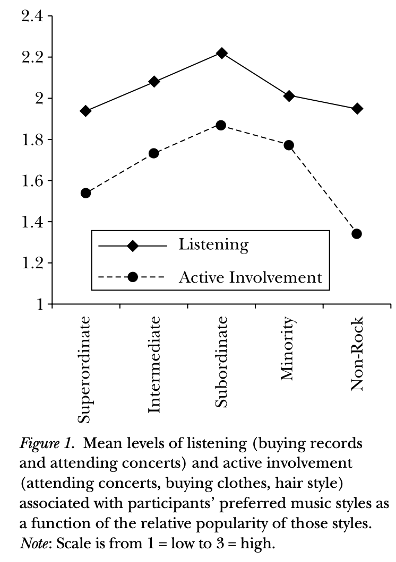
One of the most powerful demonstrations of how the need for optimal distinctiveness shapes social identity is a study of identification with musical styles among young adults. We all know that young adults often passionately identify with bands and musical styles and use them to form their identities: they go to concerts, buy albums, wear band t-shirts, and adopt distinctive hairstyles. In 2009, Dominic Abrams studied young adults’ level of investment in musical identities in relation to the popularity of the music style. He surveyed young adults about what music styles they favored and ranked them by popularity. Pop/rock and disco/dance were the most popular or “superordinate” choices, followed by genres with a smaller niche, like funk, house, and goth music. Abrams found that it was minority genres that were intermediate in popularity that had the strongest influence on their fans’ identity. Fans of moderately popular genres spent the most time listening to music and were the most likely to wear fashions and hairstyles that marked their membership in the group.
The need for optimal distinctiveness also explains much about how we see ourselves. Cynthia L. Pickett and her colleagues predicted that, since social identities provide people with distinctiveness and belonging, people would see themselves as more like typical group members when their need for distinctiveness or belonging was threatened. This response is called “self-stereotyping.” One experiment measured how university honors students reacted when psychologists experimentally aroused a need for assimilation or differentiation. When subjects were made to feel that they were very different from other honors students, they coped by self-stereotyping. They ranked themselves high on traits that stereotypically characterize honors students, like intelligence, studiousness, and ambitiousness, but not on other traits. When other subjects were made to feel that honors students were highly similar to the average student, they also recovered their sense of distinctiveness by self-stereotyping. In a similar experiment described in the same article, many university sorority members even rated themselves high on negative traits that stereotypically defined their group, like materialism and snobbishness, when their need for distinctiveness or belonging was threatened.
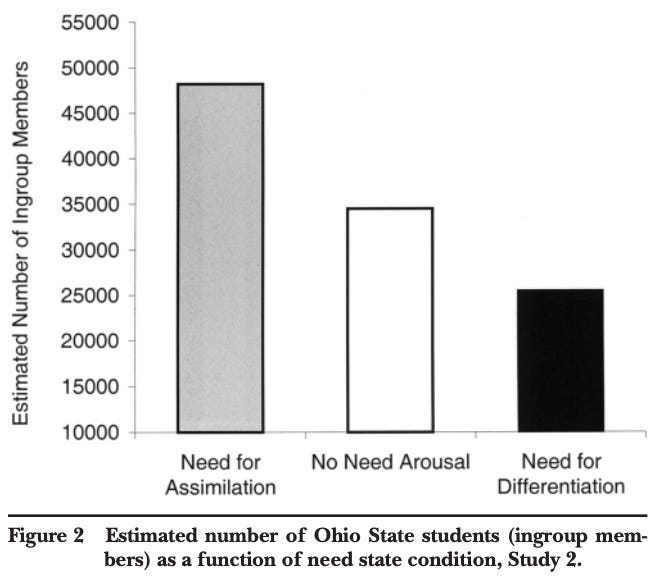
Optimal distinctiveness theory also explains how we perceive the groups to which we belong. Pickett and colleagues predicted that when people’s sense of belonging was threatened, they would overestimate the size of their reference group to make themselves feel that they were similar to a large body of people. The opposite effect was expected when people’s sense of distinctiveness was threatened. The psychologists induced need for assimilation and differentiation in Ohio State University students and asked them to estimate the number of total students at the university. Subjects in need of assimilation overestimated the number and those in need of differentiation underestimated it. Control subjects whose identity was not threatened were approximately accurate in their estimation of how many students there were, 35,647.
Uniqueness and product choice
One way in which people gratify their need for uniqueness is through their belongings and self-presentation. Wearing distinctive clothes or choosing an unusual car brand is a relatively safe way of establishing your uniqueness. People might think your weird shoes are ridiculous, but shoes are less likely to anger people than controversial opinions.
Snyder and Fromkin discuss a number of studies in which subjects were presented with products that were either scarce or common. Subjects were willing to pay more for the same item when it was presented as scarce. This effect was particularly strong among individuals with a high need for uniqueness or who scored high in fashion leadership. Later research found that consumers gratify their need for uniqueness by seeking out innovative and customized products. People also seek a sense of uniqueness by shopping at small, less popular venues, like thrift stores, specialty stores, and flea markets, as opposed to mass merchandizers like K-Mart.
Our product choices express our need for belonging as well as our need for uniqueness. College social groups, like preppies or hipsters, choose products that signal both group identity and distinctiveness. For example, group members may favor a clothing brand that distinguishes them from other groups, but express their individuality by choosing brand offerings in unusual colors.
Appealing to the need for uniqueness is a common advertising tactic. In fact, a survey of ads between 1900 and 1980 found that such appeals were a theme in 23% of ads.2 Snyder and Fromkin reproduce several such ads from the 1970s, including the ones below.
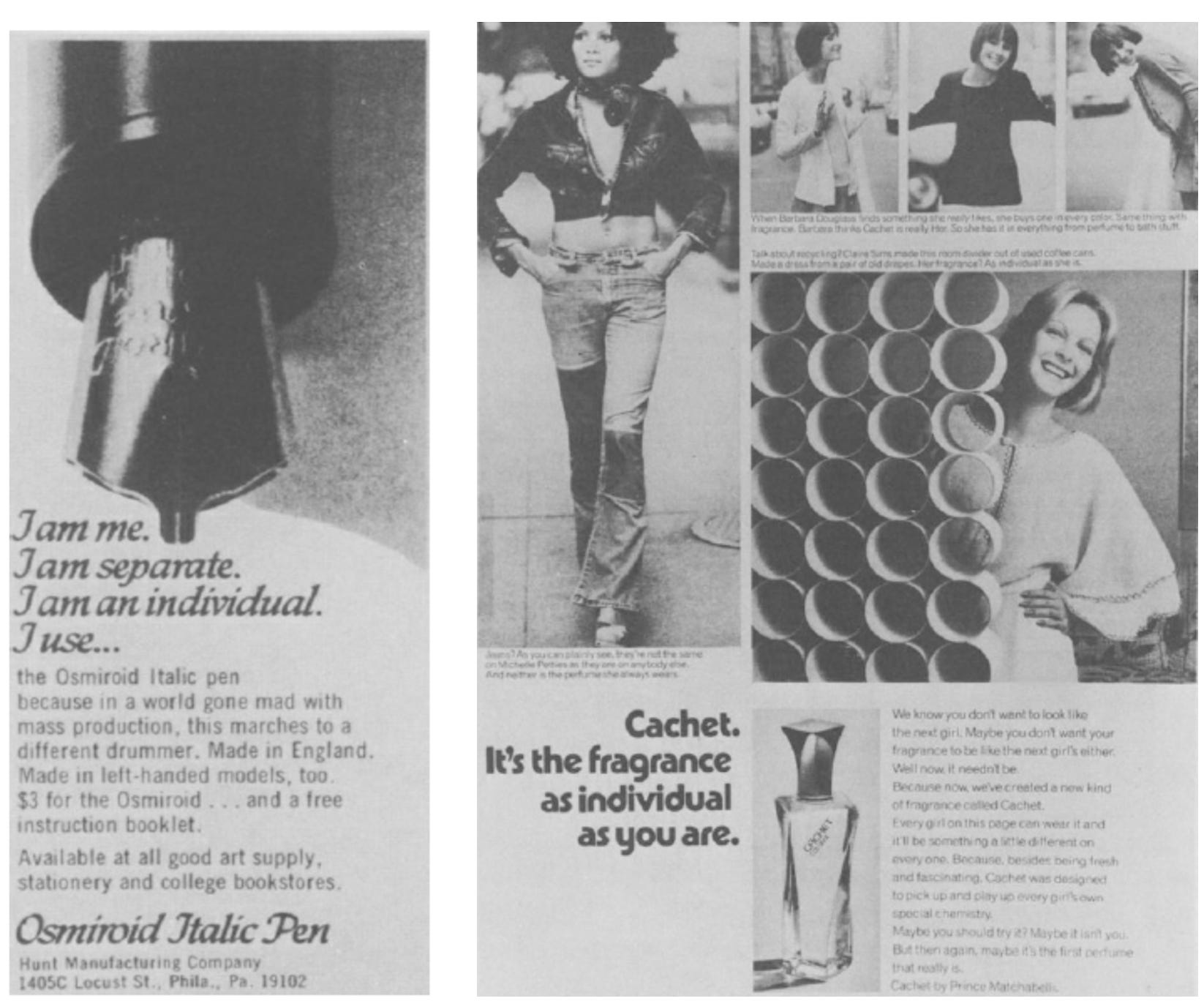
More recent advertisements also appeal to the need for uniqueness. AirBNB’s “Live There” ad campaign appealed to travelers who were tired of “mass produced tourism” and desired a travel experience that was more tailored to their unique preferences. The car brand Mini Cooper’s “NOT NORMAL” campaign stressed the brand’s “individual,” “independent,” and “unconventional” nature.

Why are doppelgängers and clones scary?
Snyder and Fromkin speculate that the need for uniqueness explains why humans who are exact duplicates evoke an uncanny feeling of horror. They discuss the character of the “doppelgänger,” or exact double, who became popular in 19th century fiction. Many fiction writers, including Edgar Allan Poe, Fyodor Dostoyevsky, and Henry James, depicted characters who were haunted and horrified by a doppelgänger. Typically, doppelgängers fill protagonists with a great anxiety, accompanied by “a strange feeling of kinship.”
The actual confrontation with the double was extremely anxiety-producing and mobilized some form of defense. The defense employed included flight, unconsciousness, attack, denial, and death. All of the characters felt such a threat from the double to their individual and unique existence that they had to find a means, at times drastic, to cope.3
It may be that these doubles are disturbing to us because they deprive us of a sense of uniqueness. If other people are identical to each other, then perhaps we ourselves do not possess the uniqueness that we assume we do.
In contemporary fiction and film, clones provoke similar anxiety. Clones are associated with the monstrous, and they are generally created by people with bad intentions. As film scholar Kate O’Riordan writes:
Human clones, and otherwise genetically modified humans have been represented as monstrous, and evil, in a range of films. These include the overlapping genres of medical horror, body horror and science fiction… Images of cloned bodies also bear traces of links to versions of nearly human others, such as automata, golems, robots, vampires, AI, other animals and aliens. Fictional human cloning scientists… have also been represented as ‘maverick’, weak or evil.
A character’s encounter with their clone is typically a nightmarish experience that leads to madness, death, or both. As an example, in the 2013 science fiction thriller Oblivion, protagonist Jack Harper encounters his clone and fights him (it?). This encounter is decisive proof that Harper’s life is a lie. Whereas he had previously believed himself to be making earth safe from alien enemies, he now realizes that the aliens have created him and his clones to help the aliens complete their genocide of humans. Eventually, this realization will result in Harper’s suicide mission to destroy the aliens’ spaceship.
A less gut-wrenching experience of uniqueness deprivation occurs when a person shows up at a social event and finds that someone else is wearing the same shirt or even the same outfit as they are. People are notoriously embarrassed by such events, and the need for uniqueness seems like a plausible explanation.
The false uniqueness effect
People overestimate their distinctiveness, a phenomenon known as the “false uniqueness effect.” This effect is due to a confluence of factors. One is the need for uniqueness just discussed. Another is the positive illusions that I discussed in my last essay. People want to believe that they are above average on positive traits and below average on negative ones.
The third factor is cognitive biases, which John R. Chambers discusses usefully in his article on the false uniqueness effect. Chambers accepts that people are emotionally motivated to see themselves as superior to the average person in order to maintain a positive self-image. However, much of the false uniqueness effect cannot be explained in this way. For example, while people rate themselves as above average at easy tasks, like using a computer mouse, driving, and solving simple math problems, they also rate themselves as below average at difficult tasks like juggling, computer programming, and solving difficult math problems.
What’s going on here? It turns out that there are other non-motivational, cognitive reasons for the false uniqueness effect. One of these is egocentrism. When asked how they compare to others on tasks, people don’t actually compare themselves to other people. Rather, they think about their own experiences with the tasks and use their assessment of their ability to formulate an estimate of their relative ability. When people say that they are better than average at driving, but worse than average at computer programming, what they really mean is that they feel comfortable with driving, but not with programming.
Part of the reason for egocentrism is that information about ourselves is more readily available than information about other people. People may judge themselves to be worse than average at public speaking because they have vivid and easily recalled memories of failing at public speaking. Information about the quality of others’ public speaking is much harder to access. Psychologists have found that they can eliminate or diminish egocentric bias by making people think explicitly about the mental states of others. In one set of experiments described in the Chambers article, subjects overestimated the importance of their contributions to a team task, but the overestimation vanished once the psychologists induced them to think about the contributions of others.
Similarly, false uniqueness effects are reduced if subjects are made to focus on another person rather than themselves. If you ask a college student, “Compared to the average student, how likely are you to earn a good-paying job after graduation?” you will see a strong better than average effect. But if you ask, “Compared to you, how likely is the average student to earn a good-paying job after graduating?”, the effect disappears, as subjects focus on other students rather than themselves.
Uniqueness theory and its offshoot, optimal distinctiveness theory, suggest that the human mind is engaged in a balancing act between opposing needs for distinctiveness and belonging. It seems to me that this theory has potential applications that have not yet been explored. I hope in the future to elaborate on how these opposing needs affect the social identities that people choose. For example, it may be that evangelical Christianity is seductive to so many because it it is very effective in fulfilling our psychological needs. On the one hand, Christianity tells people that they have a unique role to play in fulfilling God’s plan, while at the same time providing them with the security of belonging to a congregation.
Snyder summarized this book, as well as much subsequent research, in a 2002 article. Go to page 414 or search on “Uniqueness Seeking.”
This statistic is quoted in this article.
Gurri, I. The double. Unpublished manuscript, University of Kansas, 1975. Quoted in Snyder, C. R., & Fromkin, H. L. (1980). Uniqueness: The human pursuit of difference, Plenum Press, Chapter 1.